Japan · 9 min read
Using trains in Japan: IC cards, tickets and luggage
A practical guide to IC cards, Shinkansen tickets, seat reservations, station changes and luggage rules in Japan.
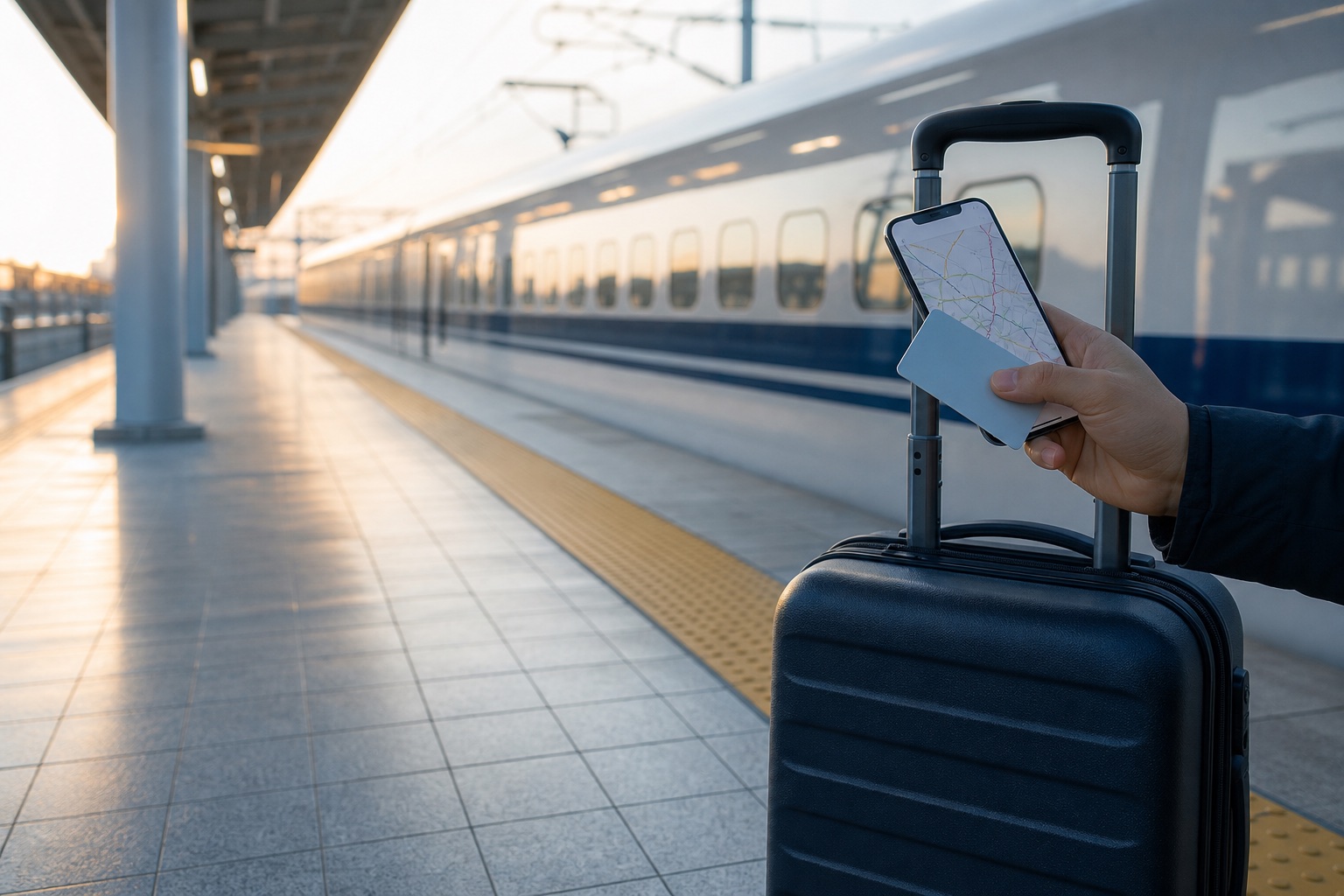
Editorial image: Trekky. Imagen editorial original de Trekky.
Quick answer
Separate three purchases: IC credit for compatible urban journeys, tickets or reservations for express trains and Shinkansen, and a pass only when covered trips justify it. A reserved Hikari Tokyo–Kyoto return is ¥27,300 as a reference in the linked official tariff table, below the seven-day national pass at ¥50,000 online or ¥53,000 through an overseas agency. Confirm dates, train, purchase channel and luggage before paying.
Three decisions before entering
Compatible urban journey: IC balance
Suica, PASMO and ICOCA hold prepaid credit; they are not unlimited passes. Check the IC symbol and route coverage, then keep the same medium on entry and exit. A card accepted in Tokyo and Kyoto does not cover every continuous journey between regions.
Express or Shinkansen: buy the product
You need the fare ticket and supplements or reservation specified by the operator. SmartEX combines base fare and supplement for its Shinkansen; IC balance alone does not buy Tokyo–Kyoto.
Pass: calculate trips within its dates
Count only covered journeys you already want to make. A seven-day pass must match your actual travel window; do not assume every metro, private operator or train is included.
Urban example: Ginza G09 to Kyobashi G10
In the Ginza Line example, from G09 towards G10 take the Asakusa direction. Check the G line letter, train destination and station before boarding. Exit with the same IC medium; for insufficient balance, use fare adjustment or ask staff. Consult Tokyo Metro’s official route search for the current fare.
Choose a physical card if your phone is incompatible or you prefer payment independent of battery life. JR East offers Welcome Suica Mobile for iOS; check device, Apple Pay and top-up compatibility before relying on it. If issuance fails outside Japan, its official notice suggests trying again after entering the country.
The short-stay physical Welcome Suica lasts 28 days from purchase and does not refund unused credit in normal use. JR East lists sales points at Narita T1/T2–3 and Haneda T3, among others: check location and hours before arrival. Top up in yen at compatible machines or Seven Bank, not with a bank card. Add credit gradually and retain the reference paper. Ordinary Suica and the mobile app have different conditions.
Real example · Ginza Line G08, G09 and G10
How to read Tokyo Metro: line, number and direction
The letter G identifies the Ginza Line and the number locates each station. From Ginza G09, numbers fall towards Shibuya G01 and rise towards Asakusa G19.

View text explanation
- Shimbashi G08, Ginza G09 and Kyobashi G10 are three consecutive stations on the Ginza Line.
- When numbers decrease from G09, the train moves towards the Shibuya G01 terminus. When they increase, it moves towards Asakusa G19.
- Ginza G09 interchanges with Marunouchi M16 and Hibiya H09. Shimbashi connects with JR, Toei Asakusa and Yurikamome.
- Look first for the line letter, then the station number and finally the terminus shown on the sign.
Trekky editorial diagram, version 1. Reviewed on 2026-07-27 by Trekky Editorial.
Intercity example: book Tokyo–Kyoto without duplicate payments
In SmartEX select Tokyo → Kyoto, date and Japan-local time, passengers and class. For the calculation below choose Hikari and an Ordinary reserved seat. Do not select Shin-Osaka thinking it is Kyoto. Check departure station, train, car and seat in the confirmation.
Use the entry method explained in your booking: QR, collected ticket or linked IC. Linking an IC identifies an already-purchased reservation; it does not pay for it from the IC balance. Local journeys to Tokyo Station and from Kyoto Station cost extra with SmartEX. For other products, check included urban zones before buying another ticket.
Trekky suggests reaching the station around 30 minutes ahead on a first journey, more with luggage or assistance. This is editorial margin, not an operator rule: include the walk to the platform. Avoid a timed attraction immediately after arrival.
Reproducible calculation: Tokyo–Kyoto return
Example for one adult, Hikari, Ordinary reserved seat, regular season and two journeys within seven days: SmartEX’s currently linked PDF lists ¥13,650 each way. Two tickets total ¥27,300. The PDF dates this reference tariff to 1 April 2025; it was checked on 4 October 2026. Confirm your travel dates before paying.
The official Japan Rail Pass website lists ¥50,000 for a seven-day adult Ordinary pass bought online and ¥53,000 through a JR-designated overseas agency. Against ¥27,300, another ¥22,700 or ¥25,700 respectively in covered journeys would be needed to reach that price. Local and airport travel are excluded from this calculation; list them separately.
Nozomi/Mizuho require an additional special ticket with the Japan Rail Pass: do not compare those services as if fully included without it. If you add cities, recalculate costs and coverage for the trains you will use and compare a regional pass too. Outbound on day 5 and return on day 12 span eight inclusive days, so a seven-day pass cannot cover both.
Luggage, rejected gate or missed train: a concrete next step
On Tokaido/Sanyo/Kyushu and Nishi Kyushu services, luggage over 160 cm and up to 250 cm in combined height+width+depth needs a seat with oversized-baggage space. A 75+50+30 bag totals 155 cm; 80+55+35 totals 170 cm and changes the reservation needed. Space behind the last row is not freely available to every passenger.
JR Central allows additional storage options for bags up to 160 cm; do not assume a shared space will be empty. If no oversized-baggage seat remains, choose another train or arrange forwarding with a confirmed delivery time. Keep documents, medication and a minimal delay kit with you.
If the gate rejects your medium, do not enter again using another or follow someone through: show staff your origin station, entry card or device and ticket. For a missed train, check your exact purchase conditions. With oversized luggage you must arrange another space reservation; any permission to use an unreserved seat does not solve the luggage requirement.
In Trekky create your trip and record station, local date/time, train, car, seat, entry method and confirmation. Choose “Create my trip” to begin organising these details and preparing each transfer. Without Trekky, keep the same details downloaded and the operator link.
Sources and review
Written and reviewed by Manuel. Founder of Trekky and traveller across 36 countries. Last reviewed: 4 October 2026.
Each guide separates official facts from editorial recommendations, links its sources and displays its latest review date.
- Official Ginza Line stations · Tokyo Metro
- Travelling by train and bus · Japan National Tourism Organization
- IC transport cards · Japan National Tourism Organization
- Oversized luggage on Shinkansen · Central Japan Railway Company
- Welcome Suica Mobile: compatibility · JR East
- Physical Welcome Suica: conditions · JR East
- SmartEX: booking, boarding and coverage · JR Central / JR West / JR Kyushu
- SmartEX: Hikari Ordinary reserved-seat fares · JR Central / JR West / JR Kyushu
- Japan Rail Pass: prices by purchase channel · JR Group
- Nozomi/Mizuho special tickets · JR Group
Found this guide useful? Share it
Keep planning your trip

Tokyo, Kyoto and Osaka, Japan · 12 min
Japan in 10 days with one suitcase: Tokyo, Kyoto and Osaka
A practical Tokyo–Kyoto–Osaka route with realistic bases, Shinkansen luggage rules, luggage forwarding, bookings and a light packing list.
Reviewed
Tokyo, Japan · 11 min
Tokyo for first-timers: neighbourhoods, transport and bookings
How to group Tokyo by neighbourhood, choose the transport you actually need and book viewpoints or museums without turning the trip into a race.
Reviewed